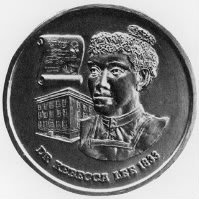
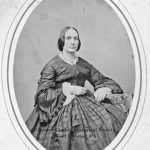
Doctor and Teacher for the Freedmen’s Bureau
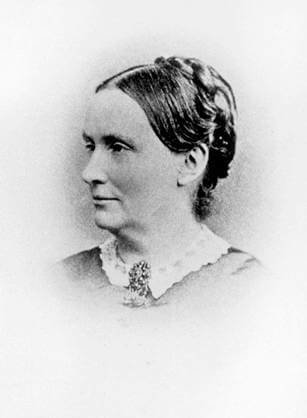
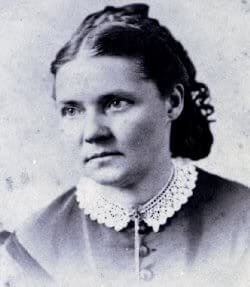 Unable to serve as an Army Surgeon because of her gender, Dr. Esther Hill Hawks educated newly freed slaves on Hilton Head Island, South Carolina. After the war, she established Florida’s first interracial school, but in January 1869 her new schoolhouse was torched; she returned to New England to practice medicine.
Esther continued teaching after the colony’s decline, but in January 1869 a new schoolhouse was torched and in 1870 she returned to New England to practice medicine.
Early Years
Esther Hill was born on August 5, 1833, the fifth child of Parmenas and Jane (Kimball) Hill, in Hooksett, New Hampshire. After she finished public school she went on to an academy at Kingston, New Hampshire and became a teacher.
Esther Hill and Dr. John Milton Hawks were married on October 5, 1854, in Manchester, New Hampshire. They honeymooned in the small town of Manatee, south of Tampa, Florida. The couple were both staunch abolitionists. After returning home, Esther began studying John’s medical books and decided to go to medical school.
Esther Hill Hawks received her medical degree from New England Medical College for Women in 1857, becoming one of the first female physicians in the United States. John, who was not as progressive in his thinking as Esther, lamented that he would have preferred her to tend to his comfort rather than her medical studies. Esther overcame his objections but was unable to overcome the gender discrimination of the era.
The Civil War
Before the War, there were more than 20 working plantations on Hilton Head Island, South Carolina. Many plantation owners did not reside on the island; mostly slaves and overseers lived there. On November 7, 1861 Union naval forces attacked Confederate Fort Walker (later renamed Fort Welles in honor of Secretary of the Navy Gideon Welles) in what was named the Battle of Port Royal. The area remained in Union hands throughout the balance of the war.
In the days following the battle, nearly 13,000 Union troops occupied Hilton Head. Hundreds of slaves flocked to Hilton Head Island, where they could buy land, go to school and live in government housing. Within two days, approximately 150 escaped slaves came to the Union army’s encampment; by December 15, there were 30. By February 1862, there were at least 600 freedmen living in the camp, and Union officers complained that the ex-slaves “were becoming a burden and a nuisance.”
The solution, envisioned by the Commander of the Department of the South headquartered at Hilton Head, General Ormsby Mitchel, was the creation of a town for the escaped slaves in a cotton field on the north end of the island and near the military camps. Unlike other contraband camps, Mitchelville (named for General Mitchel) was developed as an actual town, with neatly arranged streets and one-quarter-acre lots. The residents elected their own officials, passed their own laws, and established the first compulsory education law in the state.
Secretary of the Treasury Salmon P. Chase sent his colleague and outspoken opponent of slavery Edward Pierce to examine and eventually oversee the government effort regarding the freed slaves. Pierce and representatives from the American Missionary Association quickly devised a plan for the education, welfare and employment of the former slaves. In April 1862, a military order was issued freeing the blacks on all of the Sea Islands.
Soon after the War began, Dr. John Hawks had joined the United States Colored Troops to care for the former slaves he had advocated for in the years leading up to the war. He received an appointment as Acting Assistant Surgeon (doctors were called surgeons during the war) on the staff of General Rufus Saxton in Beaufort, South Carolina – a city on the mainland near Hilton Head Island.
Dr. Esther Hawks received a poignant letter from her husband:
I pray for the chance to stay at a good salary, so I can afford to live away from other business, then I will get you here, and we will have a fine time, [not] because it is all pleasure and no trouble, but because notwithstanding the heat, the sand, the insects, and the lassitude produced by the climate, we can do a vast amount of good. It is a growing conviction with me that the enjoyment of mortals is in proportion to the good they do their fellows.
Women doctors were not allowed to serve as army surgeons, so Esther volunteered as a nurse, but her application was rejected by Dorothea Dix, Superintendent of Army Nurses. In order to avoid sending vulnerable young women into the hospitals, where she feared they would be exploited by the men there (doctors as well as patients), Dix set strict guidelines. Her nurses had to be between the ages of 35 and 50 and plain-looking. Hawks was an attractive 28-year-old.
Eager to support the war effort and join her husband in South Carolina, Esther took a position as a teacher with the National Freedman’s Relief Association in Beaufort. She was assigned to educate the soldiers of the First Regiment of South Carolina Volunteers and their families. The First SC – the first official Union Army regiment organized with African American soldiers in the Civil War – was composed of escaped slaves from South Carolina and Florida. The men in this unit were so eager to learn to read that the army made teachers available as one of the benefits of enlistment.
General Hospital Number 10
In March 1863 the Union government built General Hospital Number 10 for African American soldiers on Hilton Head Island with a 1,200-foot frontage and a floor area of 60,000 square feet. Esther worked there as her husband’s unofficial assistant and nurse, and also continued to teach.
At one point, Dr. John Hawks was ordered to accompany a secret mission to the coast of Florida. Since a surgeon was not sent to replace him, Dr. Esther Hawks took charge of the hospital. She wrote:
I am left manager of not only the affairs of the hospital, but have to attend surgeon’s call for the 2nd (South Carolina Volunteers), so every morning at 9 o’clock the disabled are marched down to the hospital in charge of a Sergeant and I hold surgeon’s call for hospital and Regt. and with great success; on the back piazza, sending some to duty and taking into the hospital such as need extra care.
So for three weeks I performed the duties of hospital and Regimental Surgeon, doing work so well that the neglect to supply a regular officer was not discovered at headquarters. I suppose I could not have done this if my brother [Edward O. Hill] had not been hospital steward – or if the patients had been white men – but these negroes [sic] are so like children that I feel no hesitancy in serving them.
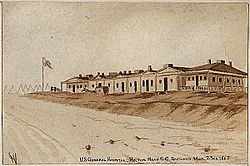 Image: Drawing of U.S. General Hospital Number 10
Hilton Head Island, South Carolina
In July 1863, the 54th Massachusetts Volunteer Infantry Regiment of African Americans gained recognition on July 18, 1863, when it spearheaded an assault on Fort Wagner, one of the strongholds guarding the harbor entrance at Charleston, South Carolina. Although Union forces were not able to take the fort, the 54th was widely acclaimed for its valor during the battle, and their brave deeds were made famous in the 1989 movie Glory.
Of the 600 men of the 54th Massachusetts who charged Fort Wagner 272 were killed, wounded or captured; their valiant colonel Robert Gould Shaw was among the dead. The wounded survivors of the 54th were carried to Hospital #10, where the Drs. Hawks worked tirelessly without sleep or rest. She later wrote in her diary:
The only thing that sustained us was the patient endurance of those stricken heroes lying before us, with their ghastly wounds, cheerful and courageous.
Thereafter Dr. Hawks spent her days educating African American soldiers and their families so that they would be able to live better lives after the war ended. She submitted this report to The Freedmen’s Journal on February 8, 1865:
The military force is so small here now, that the rebels are giving us some annoyance. Dickinson’s band of cavalry, about two hundred strong, is in this vicinity, and have recently captured several small parties of our soldiers, amounting, in all, to over a hundred men.
Our Schools are in a flourishing condition; we have an average attendance of one hundred and sixty. I have organized a sewing-school, – the children bringing such work as they have, – and we teach them to mend, and patch, and the older ones to cut by patterns, which we prepare for them. It is an interesting sight to see my sewing school; and the delight of the smaller ones, who are being initiated into the mysteries of making rag babies, is comical to see. It is the best I can do, we have so little to do with besides. I have great faith in the knowledge which comes to the children through their dolls.
Last Saturday, I visited thirty-seven different families, white and black, in town. I wish I could give you some idea of the difference between the two, – equally poor, equally dirty and destitute! The whites, have a hopeless, listless appearance; and no words of encouragement or cheer seem to reach them. They do not hesitate to beg, and are full of complaints.
There is no elasticity in them; with the blacks, it is just the opposite: they are cheerful, willing to work, do not beg or complain, and are far more hopeful objects to labor for. I ought not to have said they are equally dirty; some of them are; but we have many colored families here who are patterns of neatness; and I make them all “clean up” once a week, or as often as I go among them, which they do cheerfully, and are improving much in this respect. The health of the place is remarkably good at this time.
Esther H. Hawks
After the war, she continued to work in the area, caring for former slaves and teaching school. She kept a diary that covers the Civil War and Reconstruction. The South she described consisted of carpetbaggers, occupation troops, zealous missionaries, and freed slaves and their hungry children. She described the South she saw – conquered but still proud.
Port Orange, Florida
After the war, the soldiers and slaves that Drs. John and Esther Hill Hawks had cared for in South Carolina joined them on a trek to Volusia County, Florida, on the east coast. The Homestead Act of 1866 enabled freedmen to acquire government lands in Arkansas, Mississippi, Alabama, Louisiana and Florida. Florida was a natural choice; it was sparsely populated and for the most part undeveloped.
The freedmen settled near the Halifax River, on public lands secured with the help of the United States Freedmen’s Bureau. There, they established a large colony of freed slaves, in an area just south of what is now Daytona Beach. About 500 former slaves initially settled there. An additional 1,000 would arrive via steamboats in the following months, making this area the most populous in Volusia County at that time.
Dr. John Hawks named the settlement Port Orange. He and several other men who had been officers of black regiments during the war decided to establish a sawmill business, the Florida Land and Lumber Company. They issued shares in the venture, the former officers purchased up to $1000 in stock, while the former black soldiers put up $100 each – a large amount of money at that time.
First Integrated School in Florida
Dr. Hawks became a teacher with the Freedmen’s Aid Society, and established what was probably the first integrated school in Florida. She taught adult blacks and both black and white children. There was a delay in getting the sawmill up and running, so the people lived in crude huts at the beginning, and the schoolhouse was unfinished for quite some time.
Therefore, Esther taught her students outside, building a large log fire for warmth in cold weather. She stood on whichever side of the large fire that was “most sheltered from the smoke,” according to a letter dated December 26, 1866.
On November 19, 1867, she reported that her school was flourishing, with eight white students, fifteen full blacks and two mulattos, people of mixed racial heritage. All of the former soldiers were learning to read, and the black and white children were “playing together as harmoniously as kittens.” However, she noted in another letter that she was receiving “bitter” complaints from white parents because their children were attending school with blacks. Four white students stopped coming to class.
Other problems plagued the young settlement. The colonists certainly knew how to farm, but raising crops in Florida’s sandy soil and warmer climate required skills they did not have. They needed more seeds, more tools, more supplies and more assistance, but they received none.
According to records, corruption in the bureau and within the company itself was rampant. Agents of the Freedmen’s Bureau sold supplies that were meant for the colonists. The treasurer of the Florida Land and Lumber Company absconded with the money they had borrowed to finish building the sawmill. By the spring of 1867, only about 250 people remained. Almost half of them were children.
An agent of the Bureau wrote:
Strong men with tears come begging for anything to appease the hunger of their families. They are willing to go any distance to labor and do go 50 and 60 miles to earn a morsel to keep starvation off from day to day.
The schoolhouse was finally built and Dr. Hawks continued teaching, even after the colony failed. She also traveled far and wide to tutor students who had left the settlement, which exposed her to unsympathetic whites, who despised integrated schools.
In January 1869, her new school building in Port Orange was torched. That was the breaking point for Esther. She moved to Lynn, Massachusetts, where she was allowed to practice medicine, and remained there for the rest of her life. She had no children.
The settlement and the Florida Land and Lumber Company disbanded later that year. Many of the settlers returned to their home states or headed for local citrus groves looking for work. But a few of those original freed slaves remained, and that small settlement became known as Freemanville.
Dr. Esther Hill Hawks died on May 6, 1906 in Lynn, Massachusetts, and was buried in Manchester, New Hampshire.
In 2003, the city of Port Orange unveiled a State of Florida Historic Marker on U.S. Highway 1, which recognizes the small neighborhood that was once known as the Freemanville. In 2004, in honor of Black History Month, the City held the first Freemanville Day Celebration. Scheduled annually for the second Tuesday in the month of February, this ceremony honors the community’s African American heritage.
SOURCES
Wikipedia: Mitchelville
Hilton Head Island History
Volusia History – Retracing Florida’s Past
Human Pilgrimage: The Civil War Activities of Drs. John and Esther Hill Hawks – PDF